
Why are most orange cats male?
Why are most orange cats male? Because the gene for orange fur sits on the X chromosome. A male cat has one X, so one copy of the orange version is enough to make him ginger. A female has two X chromosomes and needs the orange version on both to be orange all over; with one orange and one black, she becomes a tortoiseshell or a calico instead. In 2025, two research teams finally found the exact change in the DNA behind it. Here is the short story, and the ginger cats in our Ginger cats collection.
The orange gene and the X chromosome
For decades, breeders and geneticists have known that orange fur in cats is “sex-linked”: it travels on the X chromosome. Males have one X and one Y, so whatever colour version their single X carries is the one they show. Females have two X chromosomes, and early in development each of their cells switches one of them off at random. If one X carries orange and the other black, the coat becomes a patchwork of the two: a tortie, or a calico if white spotting is added.
Why are most orange cats male? The numbers game
For a male, one orange X is enough. For a female to be orange all over, she has to inherit the orange version from both parents, which is simply less likely. So orange males are common, fully orange females are rarer, and most females carrying one orange copy show it as patches. Female ginger cats do exist; they are just outnumbered.
What the 2025 studies found
In 2025, two independent teams, one led by geneticist Greg Barsh at Stanford University and one led by Hidehiro Toh at Kyushu University in Japan, published their results in the journal Current Biology. Both pointed to the same place: a gene called ARHGAP36 on the X chromosome. In orange cats, a stretch of about 5,000 DNA letters is missing just before the gene. Without it, the gene becomes far more active in the pigment cells of the skin, and those cells switch from dark pigment to the lighter, orange kind. Researchers had expected the change to be inside the gene itself; instead, it was in the stretch of DNA that controls it. Reports on the studies note that this “sex-linked orange” is not known in any other mammal.
Ginger, orange, red: the same cat
Ginger, orange, red and marmalade all describe the same coat. Breeders often say red; most owners say ginger or orange. Look closely at almost any ginger cat and you will see stripes, faint or bold, which is why the ginger tabby is such a familiar sight.
A 60-year search
The idea of a single sex-linked orange gene goes back decades, yet the gene itself stayed hidden for about 60 years, as reports on the studies put it. Both teams shared early versions of their work in 2024, and the papers appeared in 2025. One team worked from a database of 188 cats, most of them orange, comparing them with tortoiseshell, calico and non-orange cats to find the one change they all shared.
No truly solid orange cats
Orange cats almost always show tabby markings, even when they are faint. Guides for cat owners explain that this comes from the way the orange pigment is laid down along the hair, so the pattern underneath shows through. Our Ginger Tabby wears its stripes proudly.
Ginger cats, embroidered
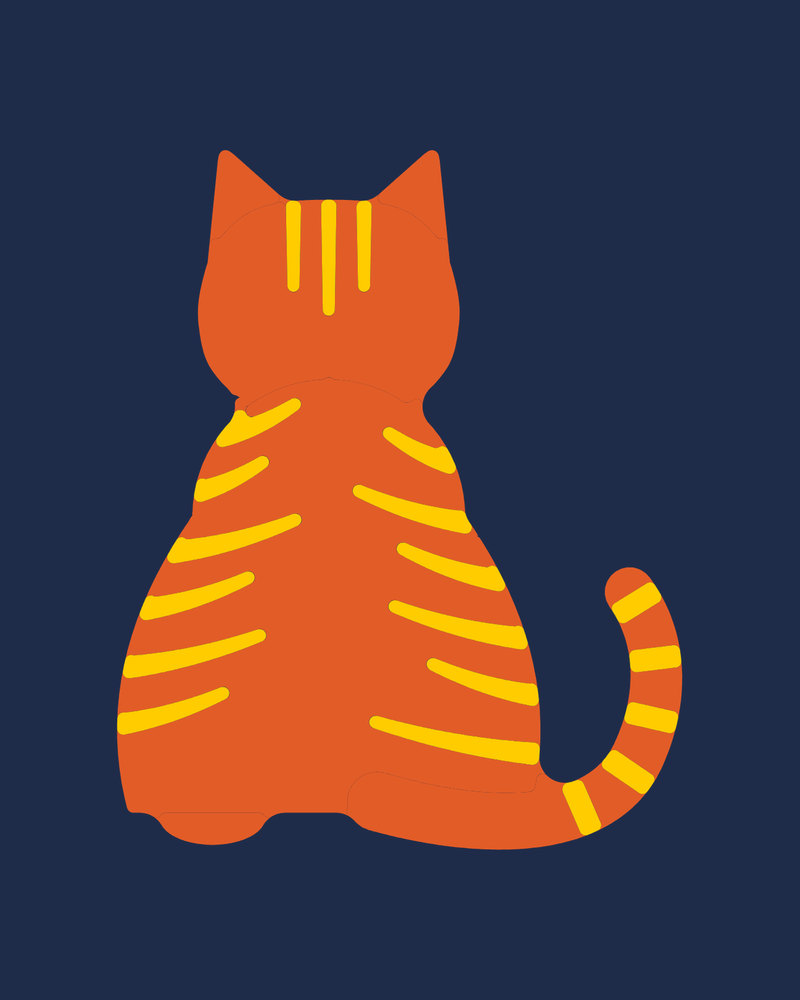
Six of our designs have a ginger cat in them, and the Ginger cats page gathers them all. The Ginger Tabby sits with its back to you, stripes down both sides; Ginger and the Yarn is one paw away from trouble; If It Fits sits in a cardboard box; and in Cats in sweaters, ginger cats wear Fair Isle and checkerboard. Every one is machine embroidered in thread on a tee, crewneck, hoodie or tote, and made for you after you order. If your ginger shares the house with a tortie or a calico, read our guide to calico vs tortoiseshell: it is the same gene, seen from the other side.
Which piece to choose
Each ginger design comes on four pieces. The heavyweight tee is 100% ring-spun cotton, garment-dyed, in sizes S to 4XL. The crewneck and the hoodie are a soft fleece of cotton with some polyester, in sizes S to 3XL. All three are a relaxed fit, so order your usual size, and the size guide lists every measurement in centimetres. The tote is one size, 38 × 42 cm. The Ginger Tabby garments come in white or true navy, and Ginger and the Yarn in white or blue jean. Every piece is made for you after you order, and each product page shows the expected delivery dates, with free tracked shipping.
Questions
Can female cats be orange?
Yes, but less often. A female needs the orange version of the gene on both X chromosomes; with only one, she usually shows orange in patches as a tortie or calico.
Which gene makes cats orange?
Two 2025 studies in Current Biology, from Stanford University and Kyushu University, linked it to a missing stretch of DNA next to the ARHGAP36 gene on the X chromosome.
Is a ginger cat a breed?
No. Ginger (or orange, or red) is a coat colour that appears in many breeds and in mixed-breed cats.
Which designs have a ginger cat?
Six: Ginger Tabby, Fair Isle, Checkerboard, If It Fits, Two Tails, One Heart and Ginger and the Yarn, all on the Ginger cats page.
Shop the designs
Ginger cats
-

Ginger Tabby Cat Embroidered Tee
From SAR 219
+8
-

Ginger Tabby Cat Embroidered Crewneck
From SAR 359
+7
-

Ginger Tabby Cat Embroidered Hoodie
From SAR 429
+4
-

Ginger Tabby Cat Embroidered Tote
SAR 159
+2
-

Ginger Tabby Cat Embroidered Washed Trucker Cap
SAR 209
+2
-

Ginger Tabby Cat Embroidered Washed Cotton Cap
SAR 199
+3
-

Ginger Tabby Cat Embroidered Dad Hat
SAR 229
+2
-

Ginger Tabby Cat Embroidered Tee, light colours
From SAR 219
+7